In the end of June, YPM sent 22 young people to participate in the Festival of East Africa cup held at Moshi – Kilimanjaro in Tanzania. The festivals took part between 28th June and 03rd July 2016.
Among the group, ten are in arts group and 12 are in the under 16 boys’ football team. This time, once again we did not manage to send the girls team. They still need to train more and get local competition to stand for the bigger events. In general the motivation for girls’ football teams is in need of boosting. Historically this is the third year since YPM begun to participate in this East African Cup festival. The participation has always been a big gist to our youth; it has helped young people learn through various seminars offered throughout the week of the festival.
Through this participation, YPM team has managed to show that they are not only for participation but more also to compete in a peaceful spirit of building a network of peace supporters. The team managed this year once again to reach the quarter finals. This is a great success as compared to the first year when we were defeated in early stages. Like last year, we managed to send a team of younger but high spirited youths. They have shown that we can compete, we can challenge one another and while doing so keep peace in the number one agenda of our activities, sports and programs. This is possible among our circles but even more a phenomenon that can be applied in international negotiation cycles as well as business rounds.
YPM arts group is a group that provides education through theater performance. They use art to warn, teach, encourage and entertain. They managed this time to teach on the effects of Female Genital Mutilation (FGM). Though not a direct theme in YPM, but in the sense of being the voice of many who suffer through such practices they managed to send in a point of rights for young girls wherever they are and in whatever part of the country or part of the world.
On 30 YPM that was when the arts group to got chance to perform. Different to other groups that were having traditional songs, YPM arts group made a play which was also having traditional songs to color the message presented. It was such an attractive, entertaining and educative performance that left many with need to get to know more of YPM.
In this festival there were various seminars in which young people got chance to be highlighted and learning new things. In the seminars the following were given the priority for this festival:-
1. Stop Poverty
2. Leadership
3. Law of the game
4. Coaching
5. WASH
Also there was the training of media in which John Kunguru represented YPM. He managed to share and learn on
1. Filming
2. Animation
3. Cartoon
Despite some challenges that were promised to be addressed as we go on, the festival was a wonderful platform to share talents, to learn and to educate one another. Keep Alive East African Cup. YPM on behalf of the host committee and the sponsors would like to congratulate all the young people who were involved and give honor to represent different Organizations; congratulate those who kept high the standards of good discipline and for the great work they are doing.
ENVIRONMENTAL WEEK

Youth concerns about environment and climate change By Regina John Introduction: On 08th October 2016 YPM gathered 132 youths from six schools with Ordinary level and Advanced level secondary schools. The schools were…..who came with their responsible teachers. The intention of the gathering was to further the work on International Youth Day that was not implemented on the 12th of August. This was intended to make sure that there is both clear permission of participation from targeted schools and the time for them to prepare to come up with something concrete. As part of the celebrations, there were themes that were given to the Ordinary level Secondary Schools that was….. and for the Advanced Level Secondary Schools it was….. In the presentations the Youths while identifying themselves with the importance of being a participating and active youth in the community, it was also a chance to work and see what impact do they have to their surroundings; the target was thus on how they impact environment and related issues in their community. The day was colored by the representative of the District Executive Director (DED) and the Environment Department Leader from the Local Government authority.

Among the issues that were raised by youths on that day include the following; School Drop-out and environment. Environmental challenges lead to school drop-outs in many cases. This is caused by heavy punishments that students get when they go to school while late due to having duties like collecting firewood or fetching water in the morning before going to school. When they are punished they lose hope in education and refuse to go to school. This is an environmental issue because they have to travel for a long distance for water and firewood due to drought and severe deforestation. Early pregnancy and marriages. This was the concern from Prince Clause Secondary school students as one of the identified environmental challenges. This occurs after school drop-out youths especially girls find themselves having nothing to do where they decide to engage themselves in different immoral behaviours which lead them to early marriages, early pregnancies and sometimes getting HIV/AIDS. It was also shared that raping occurs most of the time when they are looking for water or firewood in the bushes. Environmental challenges also result to separation of families and marriages. Many women are divorced when they come home late from fetching water or collecting firewood which creates street children in the society.

Students from Ubiri Secondary school demonstrating school dropout and early marriage as an environmental issue. Is Environment a gender issue? Youths have discovered that environment is a gender issue by showing different challenges that both men and women face which are caused by environmental destruction. Poverty among women, women have been observed to be involved in agricultural activities and production more than men. Environmental destruction causes climate change which reduces the ability of land to produce; this causes women to suffer looking for food for their children and families. Students from Shambalai Secondary school commented that droughts and unreliable rainfall creates unprofitable agriculture. Youths are so much exposed to Poverty, hunger and Famine. Intensive use of Natural resources without replacement and restoration makes youth to be in fear of their future. Too much deforestation today which leads to lack of rain creates droughts which affect land’s ability to produce. This concern was raised by students from Lushoto Secondary School during the event. This continues to expose youths into different diseases such as malnutrition, and waterborne disease. Poverty also will exceed as so many Africans families incomes depend on agriculture. District Environmental Officer Mr. Lymo Government efforts toward Environmental Conservation and Restoration. On this day youths wanted to be aware of the current Government efforts towards environmental conservation and climate restoration within the district. A representative from Lushoto District Council answered by explaining different efforts made by the Government on the Matter.
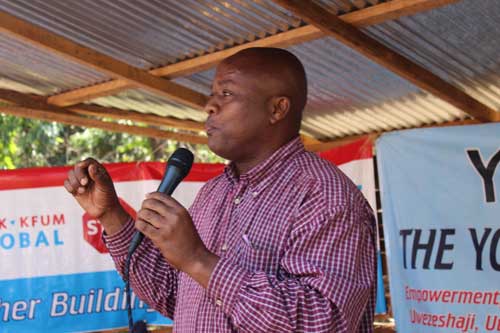
The government has imposed fines to the illegal use of Natural Resources like forest. In the year 2015/2016 they have collected 11 million Tanzanian shillings from fines imposed to the people who were caught collecting firewood, timber and burning charcoal. Also the government is making efforts to provide education to the community about environment and this made them to discover that above 1500 people in the district do not have toilets. The District also make the use of The Forest Act no 14 of 2002 which gives penalty to a person who lights fire in the forest by giving a punishment of 14 years imprisonment. Example there was a case in 2009 between the Republic versus Selemani Shempasi and four others who were convicted by the District court of Lushoto to serve five years in prison and to give compensation. All these are the Government efforts to ensure that environment is protected for today and future Generation. Do youths have a chance to give their possible solutions towards environmental conservation? During the event, youths from different schools demonstrated different ways that may be applied to ensure that environment is protected and restored for their future. Different creative strategies for environment restoration on renewable energy were demonstrated by students from Mazinde Juu Secondary school.
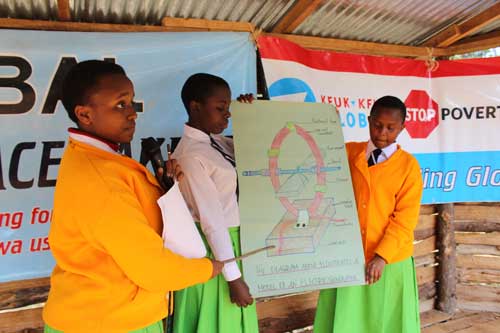
This renewable Energy is expected to be collected from wind. The aim of this demonstration was to show that community can shift from the use of firewood and charcoal to serve the environment. Students from Mazinde Juu explaining how wind can be harvested Another strategy was demonstrated by Shambalai Secondary School. They concentrated on planting trees which will reduce CO2 on air and trees will act as wind breakers. They came up with a diagram which shows the environmental impact between the area which do not have trees and the area which contains a number of trees. They added by saying that trees reduce possibilities of the occurrence of erosion either by wind or running water therefore trees do not only act as a CO2 sink but also can help in the addition of soil fertility and trees ensures the availability of water. Students from shambalai Secondary school. As the matter of energy use and poor disposal of wastes is concerned in developing countries, Ubiri Secondary school students demonstrated different ways which my be used to reduce concentration on natural resources. They demonstrated on how people can recycle used papers to make charcoal that instead of throwing them away they can be recycled. They also demonstrated how people can use the remains from charcoal (charcoal ash) to make another charcol. As the picture below demonstrate. The Question remains that: the world’s efforts is to reduce the concentration of CO2 on air by discouraging industrialization and the use of non renewable energy. For developing countries like Tanzania we are in the era of Industrialization as the motto of the 5th Government is concerned (Tanzania ya Viwanda). A student from Shambalai Secondary school named Samuel Thomas (A-Level) is asking on how will the Government take into consideration the issues of environmental conservation with Tanzania Ya Viwanda? It is suggested by the students that efforts of industrialization should consider environmental conservation for the current and future generation.
VISITORS
The whole week YPM had visitors from Haugland, Valdress and YPP and those visitors had oppotunity to sit together and discuss a few of the important things that lead to progress. Valders got a chance to visit some places like IRENTE CHILDREN S HOME, and towards the village of KWEDEGHE for purpose of learning to see the life they live Tanzanians especially those who live in rural ares and had the opportunity to participate in their daily activities. Haugland also got a chance to visit those areas.
YPM visit in Handeni

Between 14th – 16th of September, representatives from YPM head office visited activities in Handeni branch. Training and follow up were done on VICOBA and PETS, and wheelchairs donated to the local hospital. We are also in the process of setting up a computer center for youths.
VICOBA IN BRIEF
VICOBA is a Village Community Banking. It is a group that is formed by 20 – 30 people who are willing and accept the responsibility of forming, attending, respecting and abiding to the rules to be set. These groups are formed for the sake of empowering economic freedom at local and grass roots level. They are platforms for grass roots informal education and efforts to inculcate the spirit of saving from the little that they have. The amount, the regulations to guide the group and the leadership is chosen among the group members. The facilitation does not require them to pay fees, but rather support the early stages and allow them to grow.

There are many benefits from participation in VICOBA groups. It fosters cooperation on economic development by providing fast access to loans for investment in businesses. It gives chance to build a strong relationship in the given community and members of the group. It provide chances for unified voice in matters related to development in the specified community; it challenges and encourages the spirit of saving and thus loan to businesses. It encourages members to be industrious and courageous to take steps in starting small businesses as a way to stop/fight poverty. In a unified manner it equips members to raise together while holding hands of one another through insisted weekly savings. And there is profit.
Read more about VICOBA groups here
Visit to VICOBA group
At the moment there are three VICOBA groups in Handeni, and we were lucky to meet with one of them. The group was 8 months old and consisted of 30 members, which together have contributed with 2,977,000 Tanzanian shillings in the bank. This has made it possible to lend out 6,370,000 million shillings, which has been used to start small businesses like small hotels and shops.
In this visit in Handeni- Kwakonje community, the group reported that since start-up, there are peop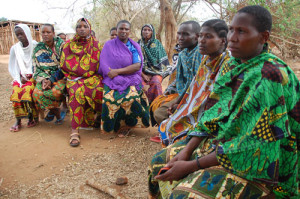 le who has taken loans and returned already. Altogether 2,884,000 shillings have been returned to the group. But time to return loans is however also mentioned as one of the challenges facing the group, and some were concerned about what to do about people traveling away without paying back. YPM advised the groups to have a clear charter of rules on how to handle delayed payments, not to lend out money to unreliable persons, and to report any form of theft to the police. Travel is not an excuse for delayed payment as modern technology, like money sent through mobile account, makes transactions possible across distance.
Another issue stressed by the YPM delegation was whether the group would keep the circle into the next year or not. VICOBA groups are mainly organized in two different ways: some are distributing back all the shares and profit once a year, and start over again (breaking the circle), while others keep the shares and distribute profits only (keeping the circle/closing the year). YPM advised all their groups to keep the circle/close the year, as this is the only way to build a strong bank which can let people lend higher amounts of money. Access to more financial resources gives greater investment opportunities to the individual, but will also benefit everyone in the VICOBA group by bringing in more profit. If a group want loans on a million shillings or more they should close the circle. The VICOBA group in Handeni has a maximum loan of 500 000 shillings today, but decided they would attempt to close the circle to increase their capacity.
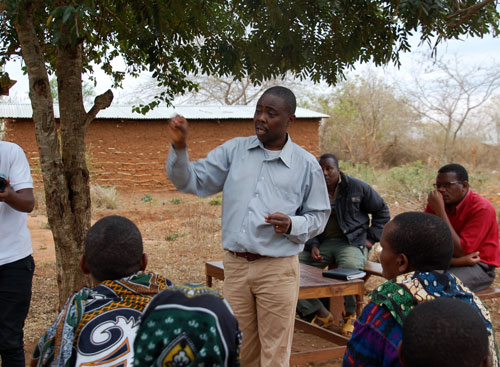
Follow up training on PETS
On Thursday 15th of September YPM held a training on Public Expenditure Tracking System (PETS) for young people from villages around Handeni. The participants presented what they had done in their local communities as follow up projects since last training. The last training held August 2015 set the group of Trainer of Trainers (ToTs) who were to go into their communities and awaken the spirit of follow up for inspiring accountability. One example of a project was done on a local health center, tracking the income from fees put on users. Every visitor to the center had to contribute with 300 shillings to pay the security guard, in addition to 1000 shillings to see a doctor, and 200 for child clinic. This fees were justified as necessary to run the center, but an account on how the money was spent, and what happened to the surplus, could not be shown.
Tracking public money, asking questions and hold leading figures accountable is all of what PETS is about. If a health center receives 1300 shillings from twenty people every day, then that makes 26000 a day, 182 000 a week, and 780 000 a month! People have the right to ask how this money is spent. Unfortunately the ambassadors of PETS still meet a lot of challenges in their work. On the training, people reported problems with cooperation with leaders and local community, lack of education among people on their right to ask, and leaders who ignored them, did not turn up on appointments, or received them with a skeptical attitude (typically who are you, and why do you ask about this).
Challenges and how to solve them were discussed, and YPM came with some advice for the future. The participants should be conscious not to do PETS alone, but teach their villages and by that creating whole communities working together as catalysts for change. Alon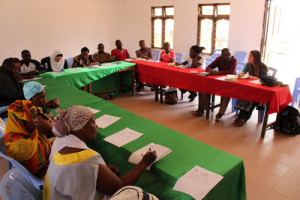 e we are weak, but together we are unbreakable. Priorities for follow up should be decided collectively in the community, and ambassadors of PETS should make sure they report back to the village to inform them on their progress, build trust and get community power. In that way we are doing advocacy with the community, not for them.
YPM is aware that PETS is demanding work and will take time, but are grateful for all achievements reach this far.
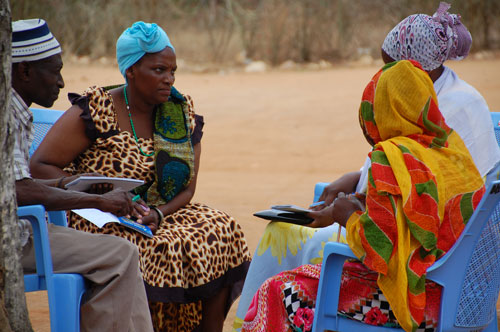
Wheelchairs to Handeni hospital
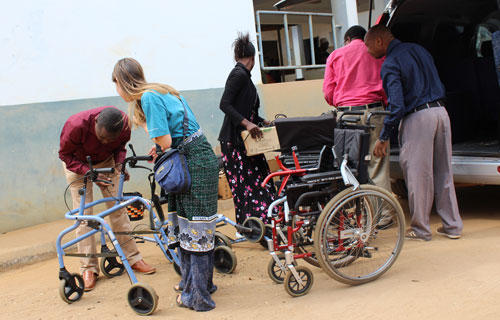
Friday morning on the 16th of September, YPM donated four wheelchairs to Handeni hospital to be used by sick and disabled people living/visiting the hospital.
Construction of computer center
YPM is planning to put up a computer center for youths in Handeni, and have donated four computers for this purpose. The center is expected to open next month. Further information will be posted.

SPORTS & GAMES FOR DEVELOPMENT.

Lushoto biking club members at YPM office on their every weekend schedule of training before starting exercise on last Saturday.The route covered 16km from Lushoto town to Nyasa go and return.
Visitor from Y-Global Norway

On September 27th, Linda Martinsen from Y Global Norway visited YPM to inspect several projects
undertaken by our organization. Y Global is an organization lying under the Norwegian YMCA-YWCA (KFUK-KFUM). They are one of YPM’s partner organizations, and have supported us with funds. As a representaive for Y Global, Linda had the chance to visit the villages of Mshangai and Kwedeghe, to see VICOBA groups and their progress.
SUCCESS STORIES
Many young people have failed to make business due to the lack of capital, but VICOBA has shown how
it facilitates easy access to capital and possibility to establish successful business. Many members have
started a business from loans that were found in their groups, and many of them have invested in
agriculture, poultry as well as small businesses.
In the villages Mshaghai and Kwedeghe, we met with three groups: Tumaini, Upendo, and Songa Mbele.
Members of these groups had taken loans, and most of them had set up businesses. Through these
businesses they can now run their families, as well as restoring the credit which were taken.
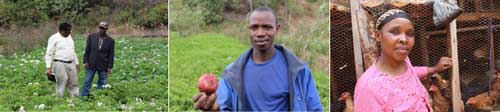
One member, Mr. Isack Baraza, had invested heavily in a major project of tomato farming. He took a loan of six
hundred thousand shillings, which made it possible for him to both start the project and construct his
own house. The tomato project has been very successful. Every week Baraza harvests twenty buckets of
tomatoes, and each of them sells for ten thousand shillings. That gives an income of 200 000 each week,
and at least 800 000 a month! With the tomato season lasting for four months, this is sure to bring good
income.

Linda learned a lot and saw how VICOBA can eliminate poverty. We hope she will take the new
experience with her when she travels home to Norway on the 29th of September.
CONTINUE TO VISIT OUR NETWORK FOR SOCIAL EVENTS AND ISSUES CONCERNING YOUNG PEOPLE
Opening of Stop poverty cup
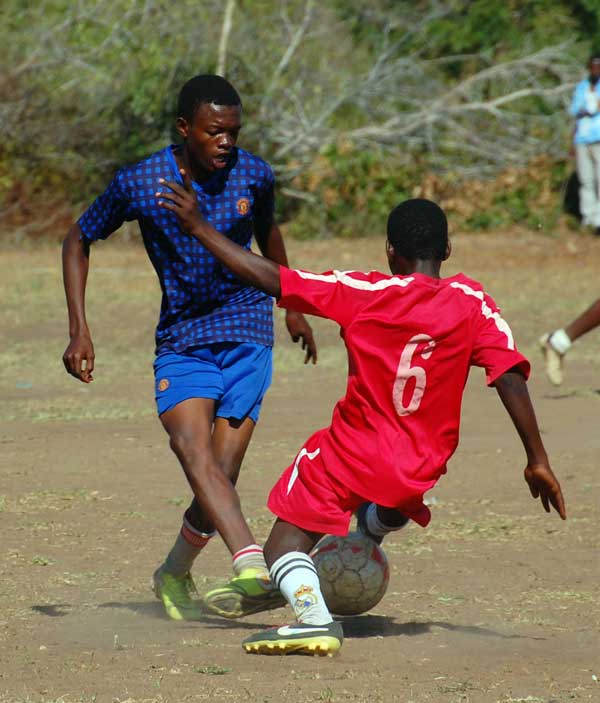
On the 29th of October YPM, officially opened the Stop Poverty Cup. The first two matches were played in Mkinga between Maforoni football club and Lunga lunga Cranes on Saturday, and a second match between Horohoro Border and Liverpool on Sunday.
What is Stop Poverty Cup?
Stop Poverty Cup is a part of the Stop Poverty Campaign, aiming at ending poverty and misery once and for all. By playing for one of our teams, we hope to increase young people’s awareness about development issues. Sport is a good arena for personal develop and boosting of talents, but also wider community development. Youths love sports and we feel that sports will be a good platform to make the voice to stop poverty and work for justice be heard to many of our targets. We encourage our young hopes to think bigger than themselves. To think of “What is my contribution to development of this country?” rather than just “what can this country do for me?” That is why we say that sports are not just for personal health, but for the health of our country as well.
Opening of the cup in Mkinga

This weekend a big opening sermon was held in Mkinga to mark the beginning of the cup. District executive director was present, together with YPM staff, YPM tensing from Lushoto, and teams from Kenya and Tanzania. Speeches were held about our main theme of stop poverty, and tensing performed a play about VICOBA. Through sports and games – the language of the youth – we hope the participants will go home wiser than before.
After the sermon, the first match of the cup were held between Maforoni footbal club from Tanzania, and Lunga lunga Cranes form Kenya. The score ended at a tie of 1-1. The match next day between Horohoro Border and Liverpool ended 2-1. YPM is happy to see that our youths are doing well and show talents and engagement.
The cup will go on until December between different teams in Tanga region. Timetable will be posted here the coming week.


– VICOBA is my motivation

During our visit to Msongolo and Ngwele last week, YPM were able to see some of the achievements brought to life by VICOBA. We call these “success stories”.
Mrs. Evelyn Apeles from Ngwele is one of the persons who got her life changed through VICOBA. With a loan of 300 000 shillings, she managed to build a new house for herself and her family.
ONLY VICOBA CAN CHANGE THIS
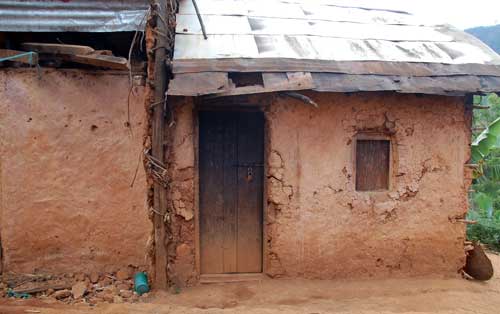
INTO THIS

Loans from VICOBA are usually invested in small, income generating projects or businesses, which assure that money will be brought in to refund the loan with interest. Mrs. Apeles does not have a business of her own, but work on a nearby tea plantation. By taking extra shifts and working hard 6 days a week, she has been able to make 450 000 shillings.
– VICOBA is my motivation. I know that for each share I save in VICOBA, I can get loan of three times as much.
Mrs. Apeles is always trying to buy five shares every week, for two thousand shillings each share. Now she is saving up to extend her house with two extra rooms, giving the house four rooms in total.